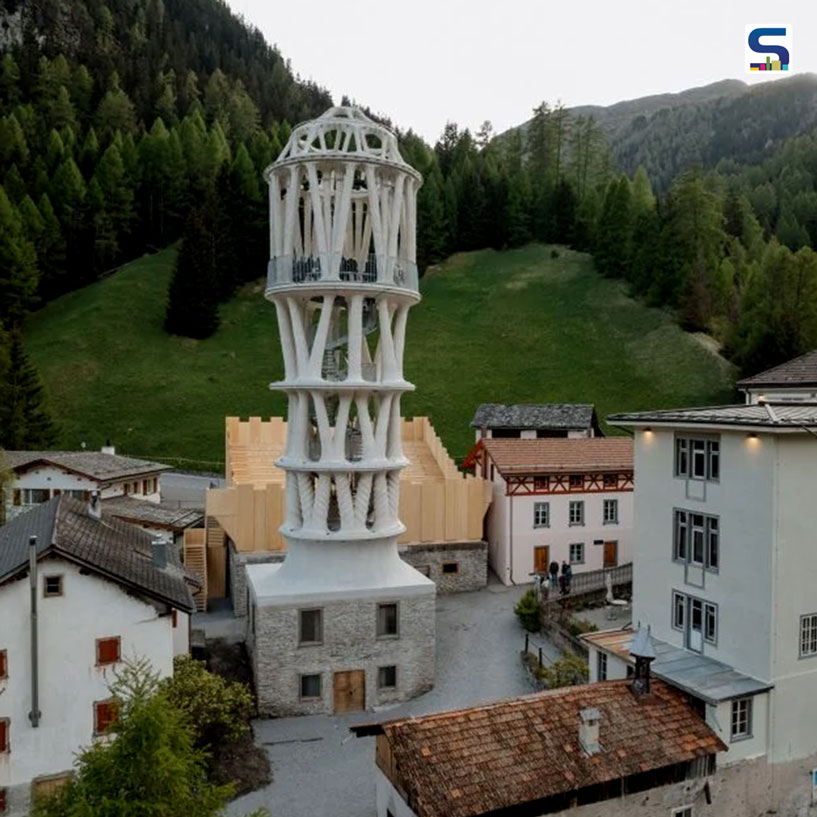
Unveiled in the quaint Swiss mountain village of Mulegns, Tor Alva, meaning White Tower, stands as a remarkable architectural and technological achievement. Rising 30m-high and composed of a network of intricate 3D-printed concrete columns, this four-storey tower is the world’s tallest 3D-printed structure of its kind. Conceived by Nova Fundaziun Origen, a cultural foundation focused on regional revitalization, the tower is the result of a pioneering collaboration with architects and professors from ETH Zurich, including Michael Hansmeyer, Walter Kaufmann, Robert Flatt, and Benjamin Dillenburger, as well as ETH Zurich’s spin-off company Mesh and construction firm Zindel United. SURFACES REPORTER (SR) showcases how advanced technology, cultural storytelling, and sustainable design blend in to form a structural victory in a village that is currently home to just 11 residents.

Each of the prefabricated concrete components was produced over a five-month period at ETH Zurich’s Honggerberg campus.
Architectural Magic
Located on the site of a former blacksmith’s shop, Tor Alva was dramatically unveiled when a helicopter lifted away the fabric covering it, revealing a form that echoes the layered shape of an ornate cake. This design not only pays tribute to the region’s landscape but also to its cultural history, specifically, the legacy of Graubunden’s confectioners who once migrated across Europe, spreading their craft far and wide. According to the team, the form of the structure is reminiscent of an ornate layered cake, a reference to the emigration history of confectioners from Graubunden who exported their skills from here to the whole of Europe.

Inside, a spiral staircase links the tower’s four levels, culminating in a domed top floor that will serve as a stage and performance venue.
The tower has been fabricated using an advanced additive manufacturing process, where robotics technique eapplied the concrete in layers, gradually building up the complex forms without the need for traditional formwork. A second robot inserted steel reinforcement rings every 20cm, while vertical rebars were added later to provide additional structural strength. This precise robotic process resulted in the tower’s distinctive droplet-like surface texture on its columns. To support this method, Professor Flatt developed a specialized concrete mix that hardened rapidly. Just before extrusion through a pressurized nozzle, two chemical additives were blended into the mix, enabling the necessary structural integrity and surface detail.

Rising 30m-high and composed of a network of intricate 3D-printed concrete columns, this four-storey tower is the world’s tallest 3D-printed structure of its kind.
Digital Innovation
Each of the prefabricated concrete components was produced over a five-month period at ETH Zurich’s Honggerberg campus. The segments were then transported to Mulegns and assembled without adhesives. Instead, they were connected using removable screws and post-tensioning cables, allowing the entire structure to be easily dismantled and reassembled. It was a conscious decision that Tor Alva is not intended to remain in Mulegns forever. After five years, it will be relocated to another site, demonstrating both its mobility and the scalability of digital construction techniques. Inside, a spiral staircase links the tower’s four levels, culminating in a domed top floor that will serve as a stage and performance venue. The tower is reportedly open to the public for daily guided tours.
Image credit: Benjamin Hofer