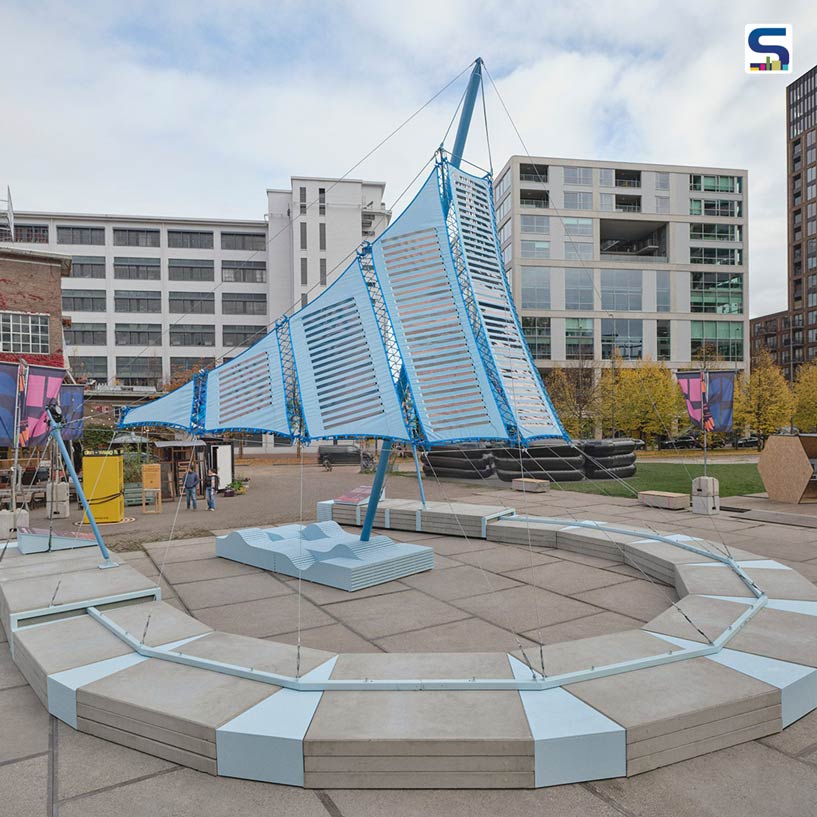
At this year’s Dutch Design Week in Eindhoven, Dutch fashion designer Pauline van Dongen has unveiled an innovative architectural installation that redefines how solar technology can be integrated into design. Titled Umbra Pavilion, the project features a striking, sky-blue canopy crafted from Heliotex, a solar-energy-generating textile made from recycled polyester yarn interwoven with 150 organic photovoltaic (OPV) solar cells. This lightweight and flexible material, developed in collaboration with Dutch engineering consultancy Tentech, captures solar energy during the day and stores it for later us. Know on SURFACES REPORTER (SR) how this advancement is marking a significant step toward more adaptable and aesthetic renewable energy applications.
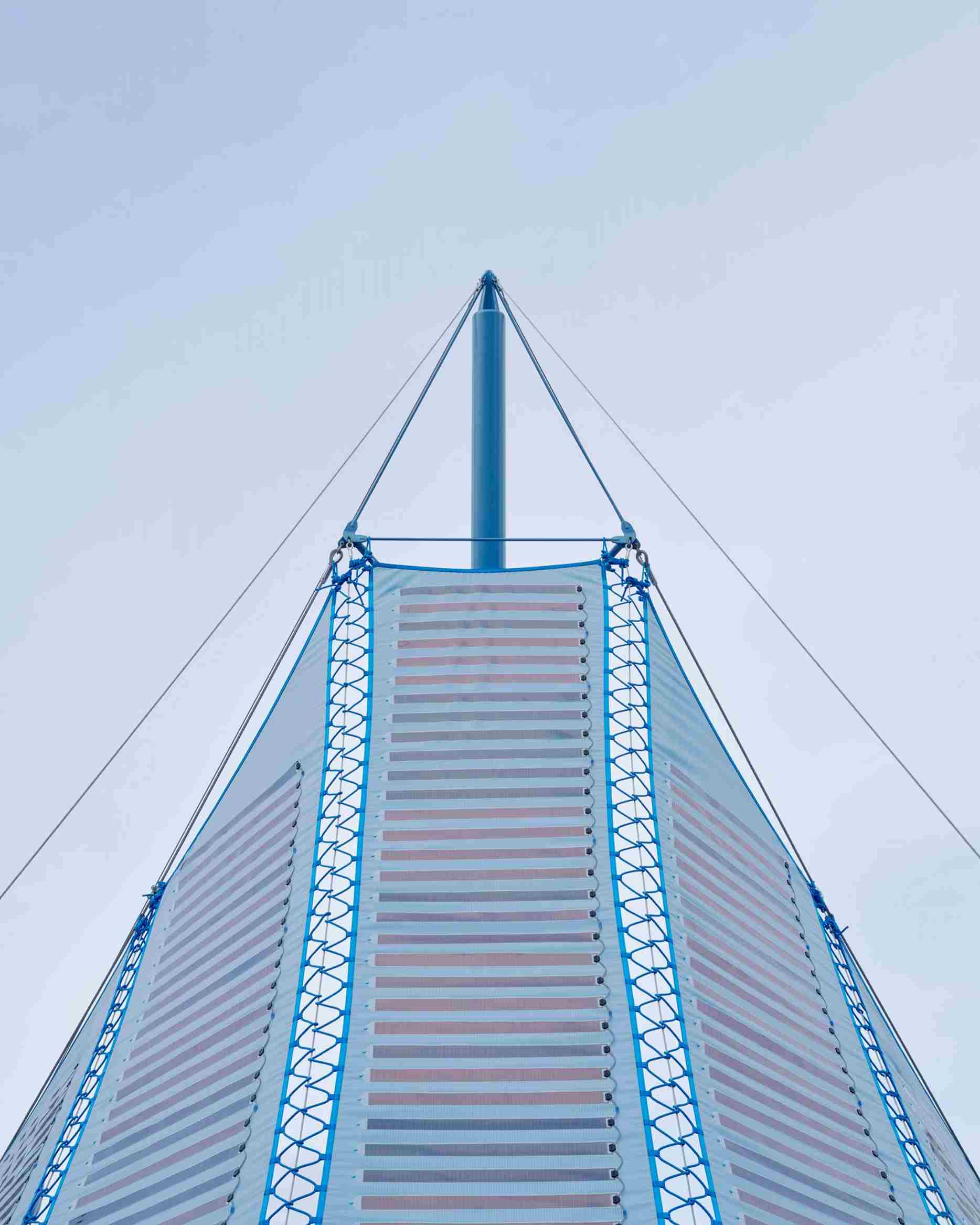
Spanning 40 sqm, the Umbra Pavilion’s canopy includes eight sqm of active solar cells, all connected to an energy storage system.
Redefining architecture
Heliotex, previously called Suntex, represents van Dongen’s continuing exploration of solar-powered materials. Known for her wearable solar garments, van Dongen expanded her vision from the human body to the built environment. By turning it into a design material, she aimed at applying it where traditional silicon solar panels can’t, including on facades, canopies or textiles that move and breathe.
Spanning 40 sqm, the Umbra Pavilion’s canopy includes eight sqm of active solar cells, all connected to an energy storage system. The installation demonstrates how architecture can merge with renewable technology while maintaining beauty and tactility. The structure’s kite-like form shades a circular seating area below by creating a calm public space. The Heliotex fabric has been designed for architectural applications such as building cladding, facades, or festival tents. Van Dongen envisions it as part of a second skin for buildings, more like an outer textile layer that can generate energy while allowing light and air to filter through. According to her, many buildings aren’t climate-neutral or positive, but one doesn’t have to demolish them. Instead, by wrapping them in solar textiles, their performance can be easily upgraded while maintaining openness and beauty.

The Heliotex fabric has been designed for architectural applications such as building cladding, facades, or festival tents.
Expanding solar technology
Technically, the textile has been engineered to endure weathering, UV radiation and fire without relying on harmful materials like PVC. Instead of gluing the solar cells, van Dongen and her team devised a woven structure that holds them in place using floating monofilament yarns. This ensures that each panel can be easily replaced, repaired or recycled, thus contributing to a circular design approach.
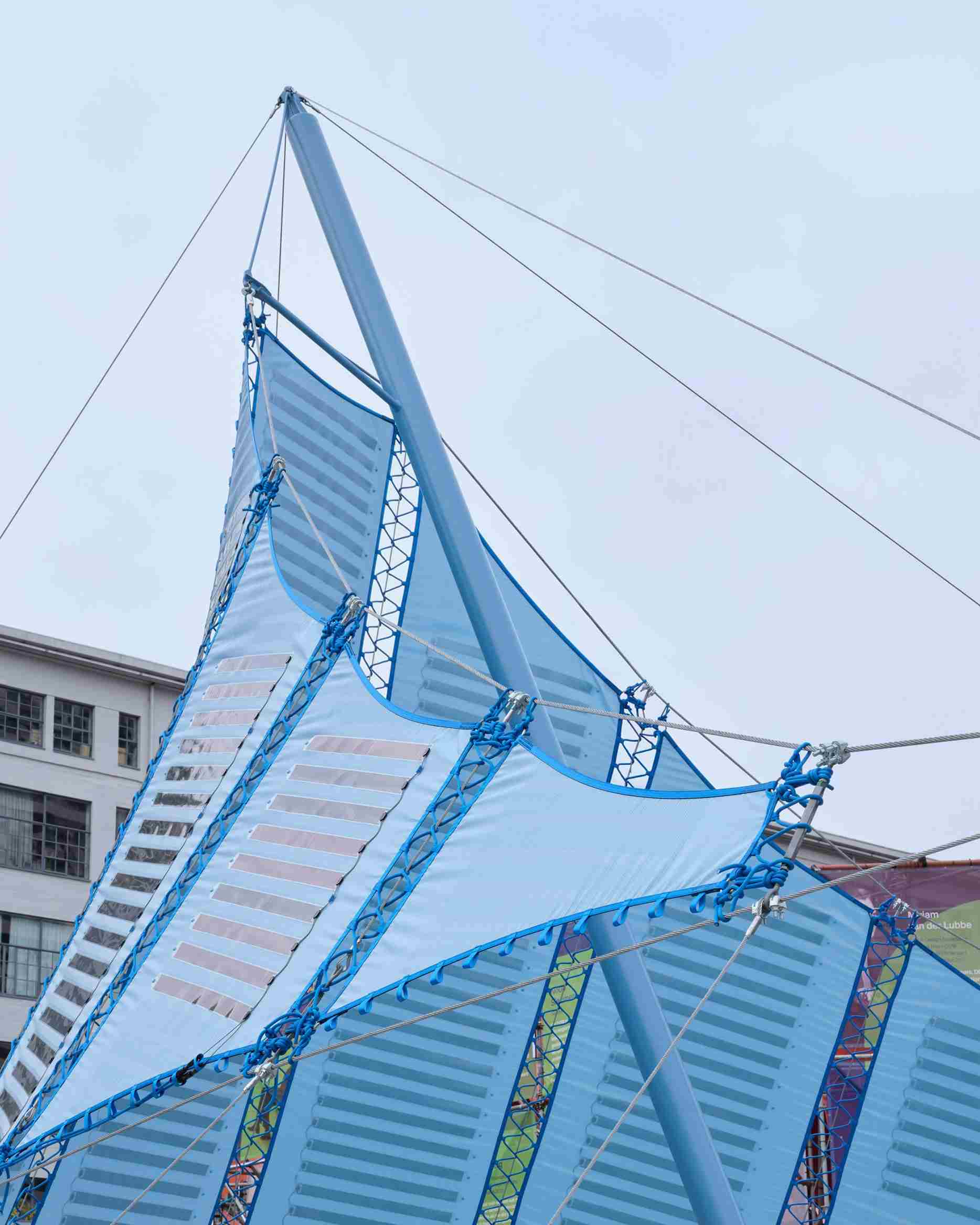
Technically, the textile has been engineered to endure weathering, UV radiation and fire without relying on harmful materials like PVC.
At present, Heliotex produces around 53 watts of power per sqm, which is roughly one-fifth of what rigid silicon panels generate. However, van Dongen’s research team is reportedly collaborating with a Danish university to double that efficiency. Heliotex evolved from van Dongen’s earlier concept, Suntex, which she introduced at The Solar Biennale in Rotterdam. Suntex proposed a vision to reupholster our built environment with solar textiles, dressing entire facades in energy-harvesting fabrics. The material, made by weaving polymer-based OPV solar cells with recycled polymer yarns, offers significant advantages over conventional panels. It is lightweight, flexible and low in embodied carbon. It can also be customised in colour and pattern. She believes this innovation could transform not only buildings but also everyday products such as tents, awnings, parasols, curtains or pool covers into energy-generating surfaces. For her, the main challenge now lies in achieving the right balance between durability, efficiency and recyclability.
Image credit: Ronald Smits