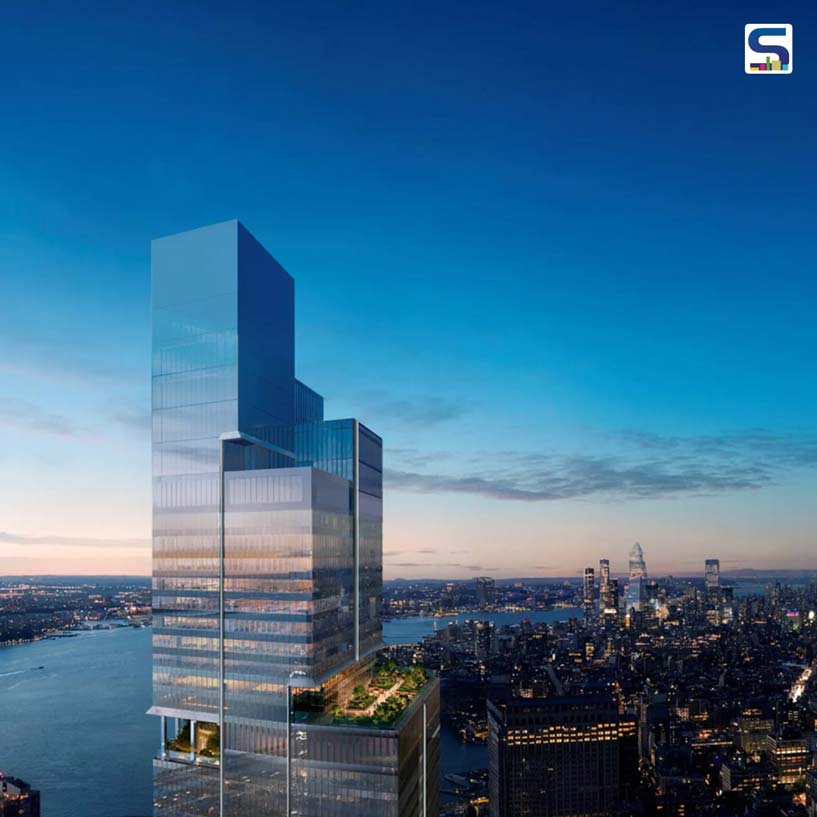
Nearly a quarter century has passed since the 9/11 11 attacks that reshaped Lower Manhattan’s skyline in an instant, and the long, painstaking effort to rebuild the World Trade Center campus is now entering its final chapter. The last major commercial tower planned for the site, 2 World Trade Center, is reportedly set to break ground in spring 2026, with construction expected to conclude by 2031. Reports suggest, American Express has already committed to establishing the building as its new corporate headquarters, anchoring the project with a significant long-term occupant before a single foundation stone has been laid. Here is a detailed report on SURFACES REPORTER (SR).
British architecture firm Foster + Partners was initially appointed to design the tower, before being replaced by the Danish-American practice Bjarke Ingels Group, whose bold terraced concept generated considerable attention. That proposal was eventually shelved, and in an unusual turn of events, Foster + Partners was reinstated and tasked with beginning the design process afresh. The outcome, revealed through recently published renderings, is a spectacular rectangular tower clad in glass, distinguished by three open-air terraces and six landscaped corner gardens integrated into the facade.
In terms of scale, the tower will reach a height of 1,226 ft, firmly placing it within the supertall category and positioning it among the 11 tallest buildings in the United States. However, it will not challenge its iconic neighbour. One World Trade Center continues to reign as the country’s tallest structure at the symbolically resonant height of 1,776ft, a figure chosen to echo the year of American independence. Inside, the new tower will encompass close to 2 million sqft of usable floor space spread across 55 storeys, the majority of which will be dedicated to office use. At full occupancy, the building is projected to accommodate approximately 10,000 workers.
While detailed specifications remain limited at this early stage, American Express has indicated that the development will incorporate smart building technologies and energy-efficient systems throughout. The project is also pursuing LEED certification. Reportedly, Silverstein Properties, the development firm responsible for much of the site’s transformation in the decades since the attacks, is leading the project once again.
Image credit: Foster + Partners