Across the globe, a significant portion of plastic waste never makes it into the recycling stream. Fishing nets, agricultural films, buoys and multi-layer snack packaging are among the most problematic offenders that are too contaminated or compositionally complex for conventional recycling facilities to handle. As a result, these materials are routinely incinerated or sent to landfills, leading to pollution. Simultaneously, the construction industry continues to rely heavily on concrete for retaining walls and structural bases, despite concrete’s well-documented environmental drawbacks. Its production is energy-intensive and emits substantial quantities of carbon dioxide and the material itself tends to underperform under tensile stress, particularly when soil movement or water pressure builds up behind a wall over time. Eco-C CUBE is a product that addresses both of these challenges simultaneously, treating what might appear to be two separate environmental problems as two halves of a single integrated solution. Here is a detailed report on SURFACES REPORTER (SR).
Structural blocks
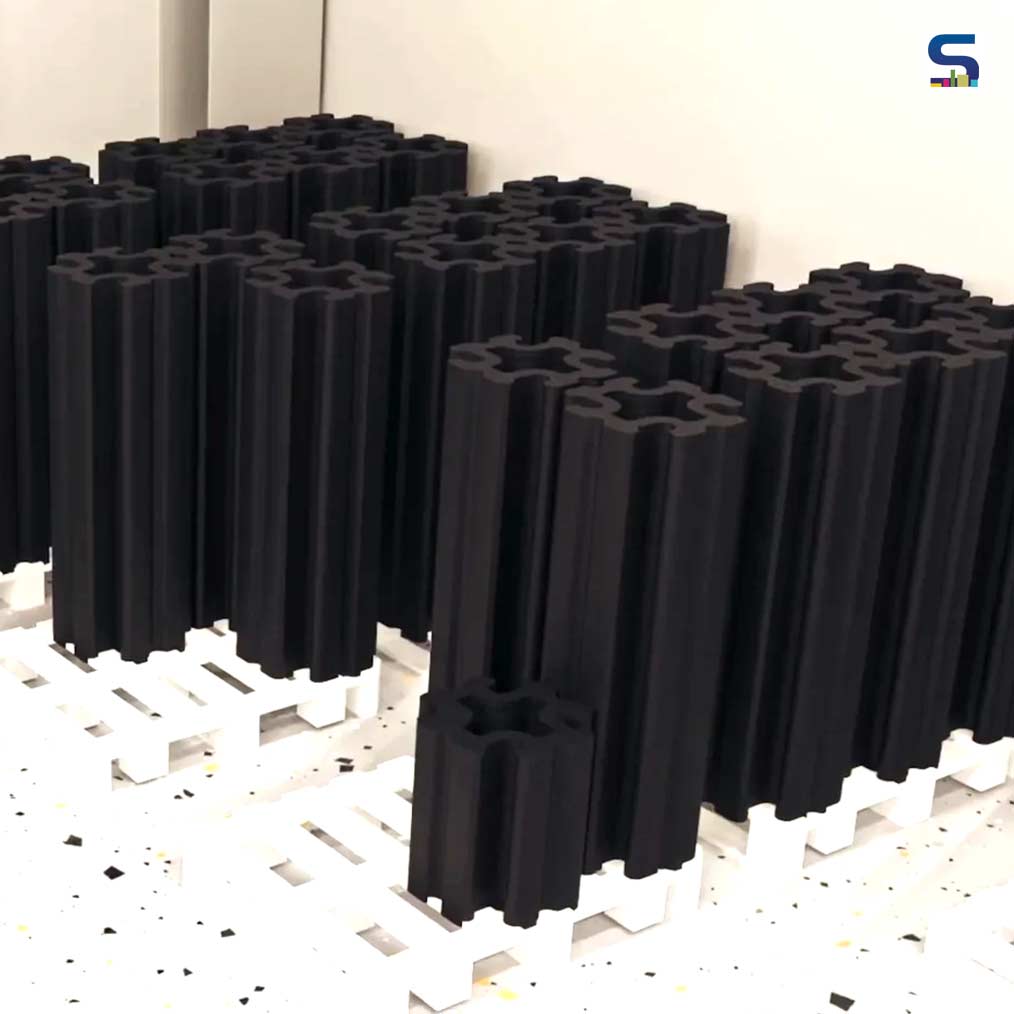
Developed collaboratively by WES-Tec Global and the Korea Low Impact Development Association, Eco-C CUBE transforms otherwise unrecyclable mixed plastic waste into structurally robust blocks purpose-built for civil engineering applications. The proprietary manufacturing method, known as the New-Cycling process, accepts fishing nets, buoys, agricultural film and similar difficult waste streams without requiring prior sorting, washing or any form of pre-treatment. These materials are melted at a carefully controlled low temperature that preserves the underlying polymer chains, then extruded directly into three-dimensional interlocking blocks engineered for retaining walls, slope stabilization and solar panel base structures.
What makes this approach particularly significant is its departure from traditional recycling logic. Conventional systems typically shred, clean and melt plastics down into pellets, a process that degrades material quality and demands considerable energy and water. The New-Cycling method bypasses these steps entirely, channeling waste straight into a production process that yields a dense, high-performance block whose tensile and compressive strength measurably exceeds that of concrete. This performance advantage is, especially, valuable in retaining wall applications, where the structure must resist dynamic forces from shifting soil, groundwater infiltration and the expansion and contraction caused by repeated freeze-thaw cycles.
Usage
The physical design of the blocks reinforces their engineering strengths. Their three-dimensional interlocking geometry allows construction crews to assemble buttress-style or box-style retaining walls without the use of cement, adhesives or any binding agents. Structural stability is achieved entirely through gravity and the precision of the interlocking system. This not only accelerates installation considerably but also simplifies future disassembly for maintenance or reconfiguration. Hollow internal channels built into each block provide a passive drainage function, allowing water to move through the wall structure rather than accumulating behind it and generating hydraulic pressure. This drainage feature aligns naturally with low-impact development principles, supporting on-site stormwater management without additional infrastructure. The environmental credentials of Eco-C CUBE extend beyond simply diverting plastic from landfills and incinerators. An independently verified Life Cycle Assessment conducted through the SDX Foundation found that each kilogram of the product reduces carbon emissions by approximately 2.99 grams relative to conventional alternatives. These savings arise from a combination of factors such as eliminating incineration emissions, skipping the energy-heavy stages of industrial washing and sorting and substituting for concrete whose production carries a high carbon footprint.
The practical applications are broad and immediately relevant. Coastal communities dealing with erosion on vulnerable hillsides could deploy these blocks in place of concrete retaining structures, simultaneously reducing carbon output and improving drainage performance. Renewable energy projects requiring stable, level bases for solar panels could choose Eco-C CUBE over conventional concrete footings, eliminating the risk of heavy metal leaching that some traditional foundation materials present.
Image credit: WES-Tec Global