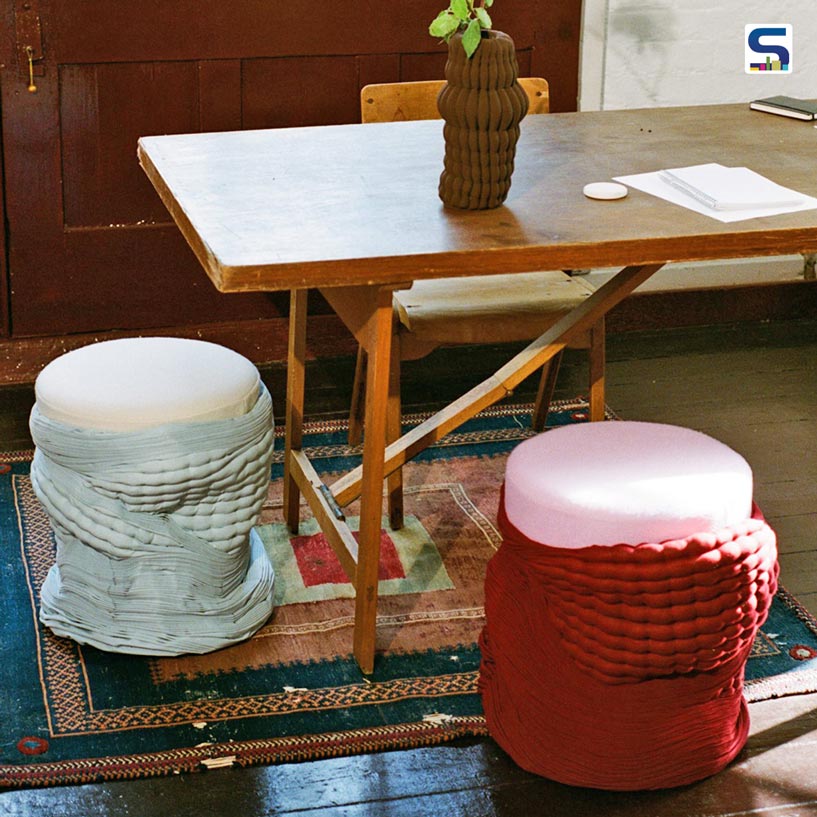
British-Brazilian designer Tessa Silva has developed a distinctive body of work that blurs the boundary between textile craft and sculptural furniture, using materials such as sand, wool and fabric to create expressive objects. Her latest work, the Smock collection, comprises a series of voluptuous vases and soft stools formed through a labour-intensive process of pleating and smocking textiles. What started as flat fabric is gradually transformed into three-dimensional forms that appear swollen, animated and almost organic in character. SURFACES REPORTER (SR) highlights how clever and skillful craftsmanship can counterpoint mass production.
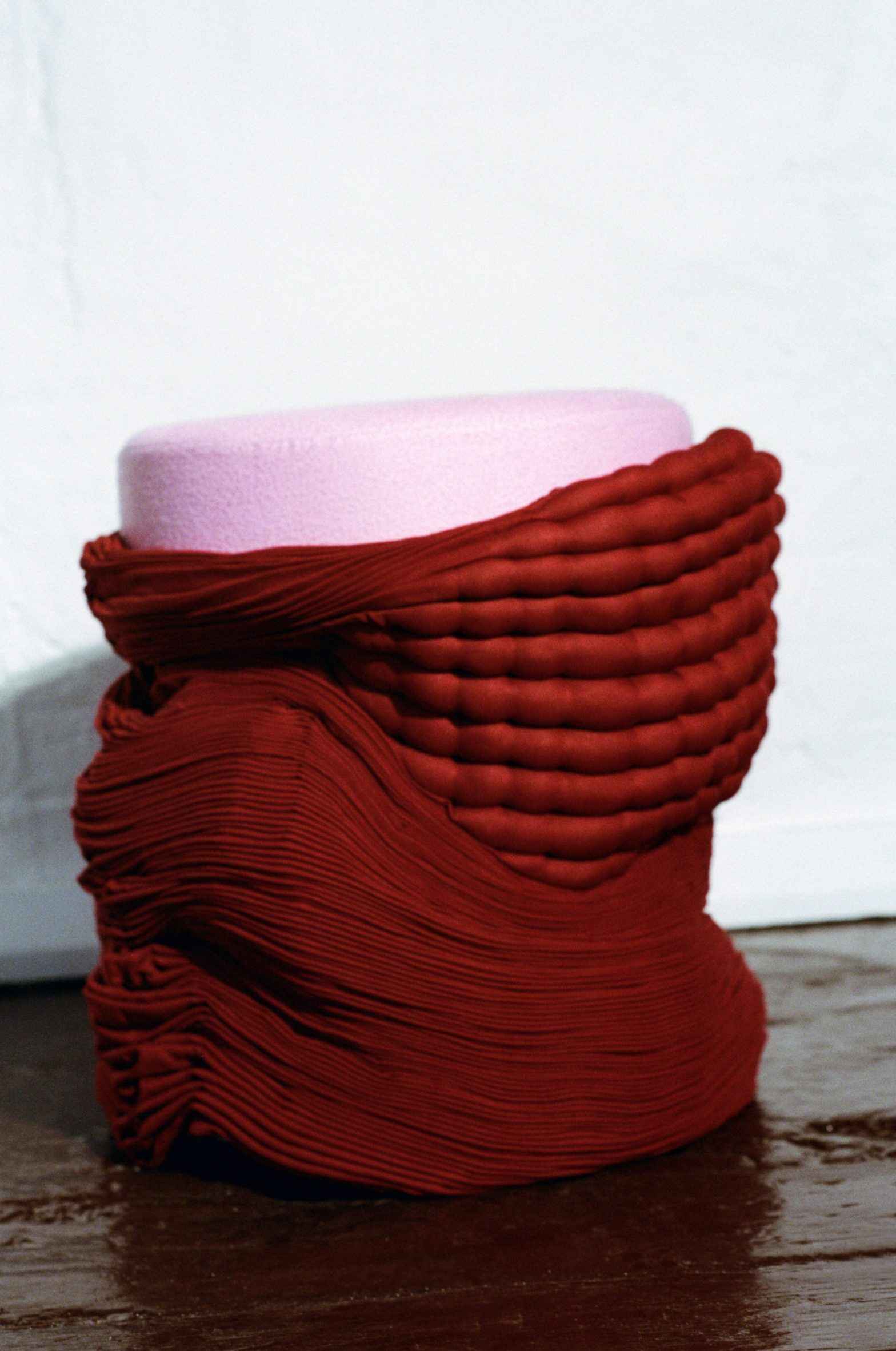
For the stools, Silva packs the pleated cavities with wool, preserving the softness and pliability of the textile surface.
Based in London, Silva has refined a self-taught technique that involves hours of meticulous hand-stitching. She works primarily with deadstock fabrics sourced from the fashion industry, folding and pleating them into complex patterns before securing the forms with thousands of tiny stitches. These stitched pockets then become containers for different infill materials, depending on the final object. For the stools, Silva packs the pleated cavities with wool, preserving the softness and pliability of the textile surface. For the vases, the folds are filled with sand combined with a sugar-derived hardening agent, allowing the fabric to set into a rigid, weighty structure while retaining its undulating texture.
The resulting pieces are defined by their exaggerated curves and uneven surfaces, with bulges and ripples that Silva describes as swelling like piped icing. This sense of movement gives the objects a lifelike quality, as though they have been frozen mid-expansion. The ambiguity of their materiality is intentional. At first glance, it is difficult to determine whether they are soft or solid, inviting viewers to engage through touch. Although the Smock collection represents a new direction in her practice, it builds directly on the themes and methods explored in her earlier work. Silva first gained attention in 2016 with her graduation project at the Royal College of Art in London, where she investigated how waste milk from cheese production could be repurposed into a biodegradable plastic. She later extended this research by combining surplus milk with chalk to create malleable, clay-like forms, a series she titled Chalk and Cheese. Those pieces were shaped using textile moulds that Silva stitched herself from discarded fashion fabrics.
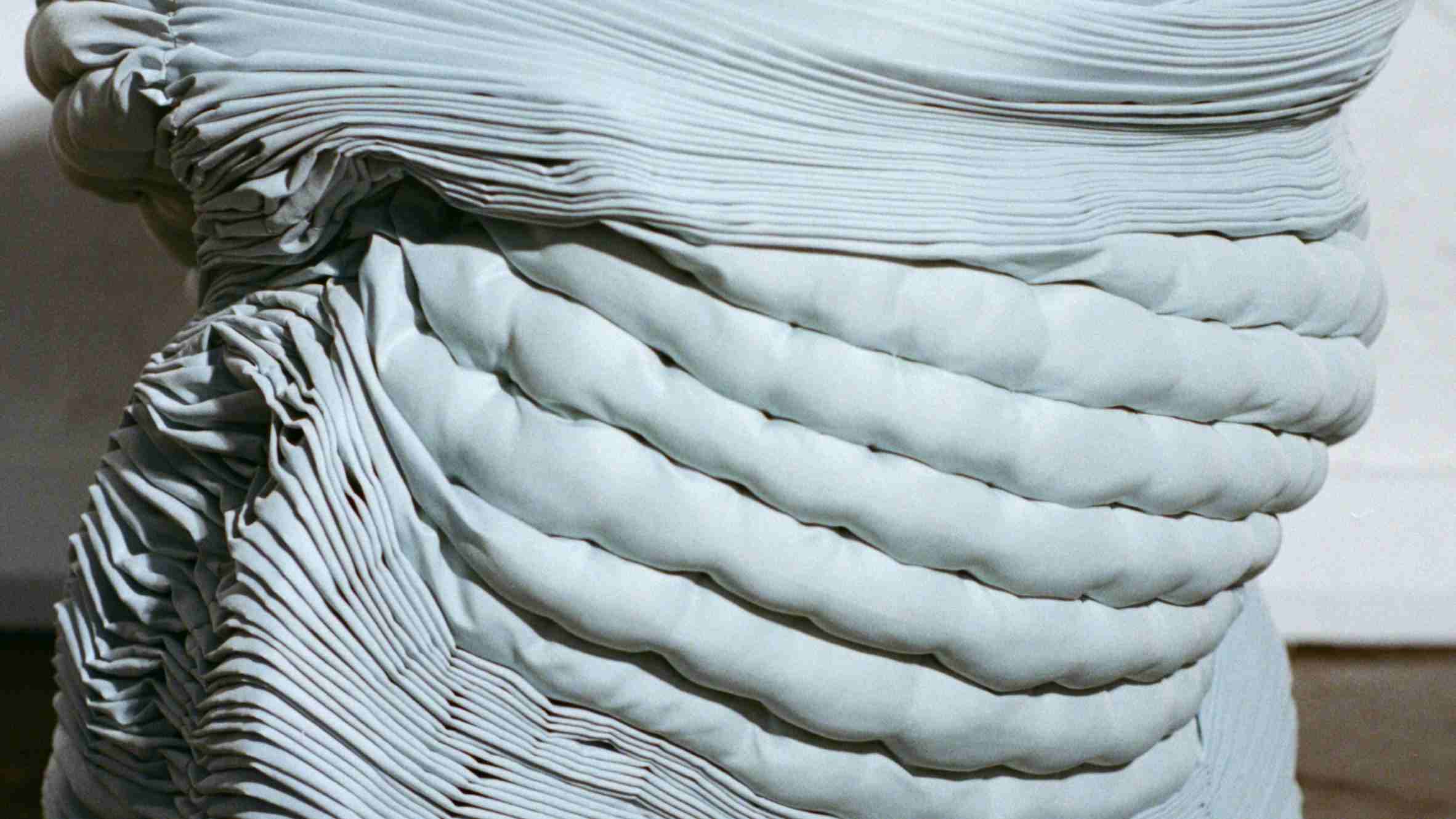
Each stool requires a minimum of 6m of fabric and more than 3,000 stitches.
Over the years, she became increasingly aware of the irony that the carefully sewn fabric moulds were stripped away and discarded once the clay-like forms had set. Rather than viewing the textiles as temporary tools, Silva began to see them as valuable in their own right. This realisation prompted her to shift focus and develop a project in which the stitched fabric itself became the final object. The Smock collection emerged as a direct response to this insight, allowing her to place the act of sewing at the centre of the design process rather than treating it as a means to an end.
Developing the collection required extensive experimentation. Silva tested a wide range of pleating and smocking techniques to understand how they would behave when scaled up and filled. A key challenge was predicting how the patterns would transform once inflated with wool or sand. Each stool requires a minimum of 6m of fabric and more than 3,000 stitches. Silva primarily uses silk-cotton blends for the main structure, upholstering the seating surfaces in wool or cashmere to enhance comfort.
Image credit: Benedict Brink