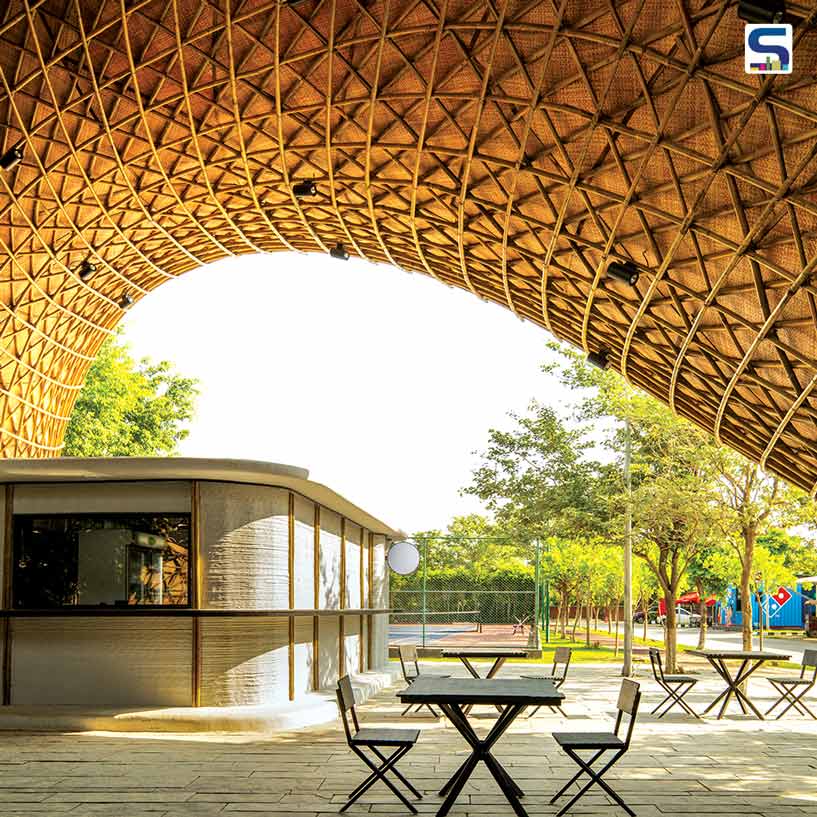
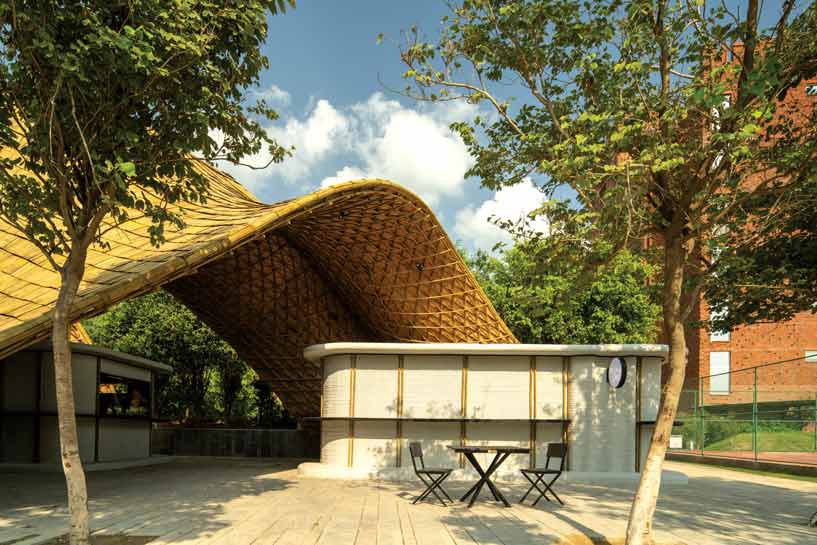
Conceived as an immersive food street rather than a mere dining stop, the House of Caterpillar is defined by a facade that draws deeply from nature, technology and responsible materiality. Nestled within existing tree canopies, the architecture takes the form of a cocoon-like structure inspired by a caterpillar at rest, shaping a playful yet protective edge to the street. Structurally designed by Atelier One (London), architecturally detailed by Jurian Sustainability and built by Jans Bamboo, the project has been designed by Ar Apoorva Shroff of Lyth Design.
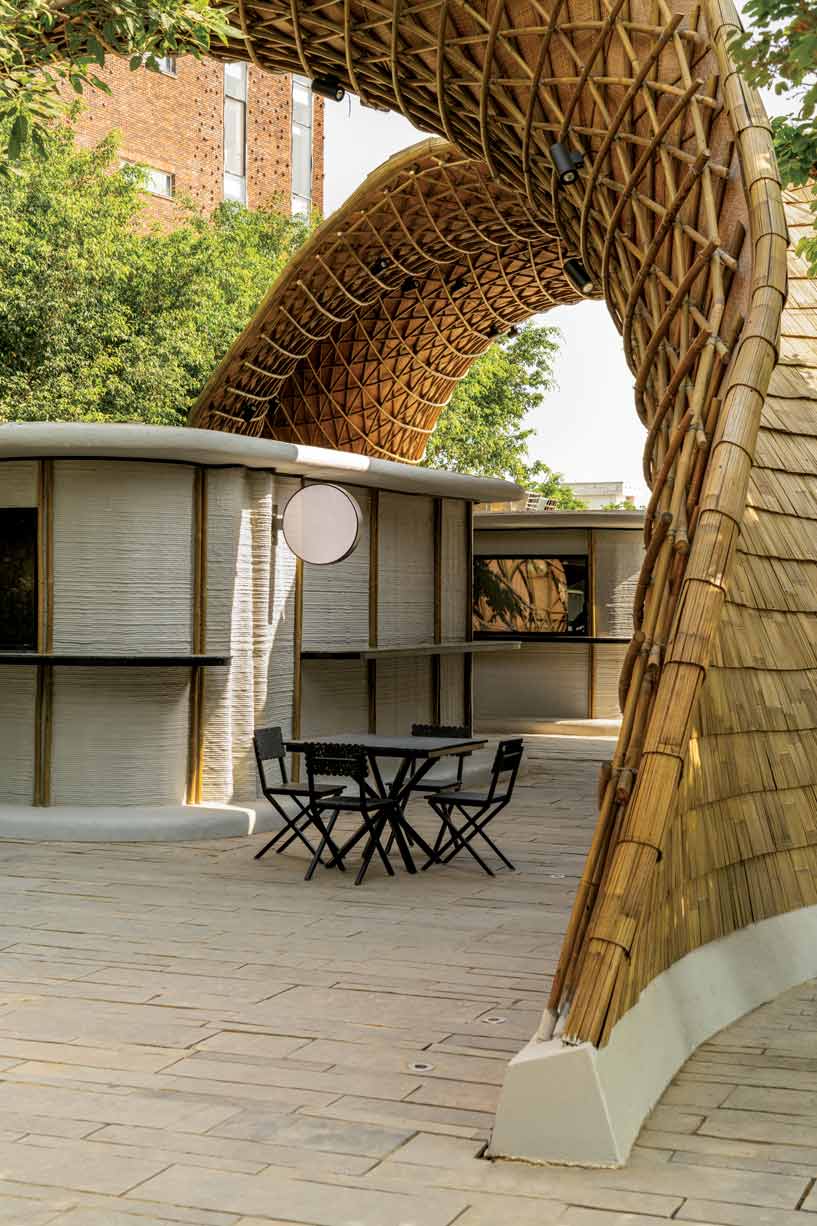
The facade and built elements are anchored by 3D-printed concrete kitchen modules, inspired by food trucks and executed by Micob Pvt Ltd, Ahmedabad. These modular units form a robust yet efficient frontage, with the additive printing process reducing material waste, energy consumption and construction time. The cavity walls of the printed concrete further enhance the facade’s thermal performance, thereby improving comfort while lowering heat gain. Hovering above, the defining visual layer is a bamboo gridshell canopy that functions as both a facade and a shading device. Curving in two directions, the bamboo shell mirrors the efficiency of folded leaves, achieving strength with minimal material. Spanning up to 19m, the structure comprises four layers of slender bamboo members laid at 45 degrees and f inished with crushed bamboo mats.
PROJECT DETAILS
Project name: The Hungry Caterpillar
Location: Ashoka University, Sonipat, Haryana Completion year: 2025
Area: 650 m2
Studio: Lyth Design, Mumbai
Principal Architect: Ar Apoorva Shroff
Photographs: Avesh Gaur and Sohaib Ilyas

Ar Apoorva Shroff Lyth Design, Mumbai
Founded by Apoorva Shroff, Lyth Design is a boutique architecture and interior practice driven by spatial storytelling and sustainable thinking. With a diverse client base including SoftBank, Prestige Group and Ashoka University, the studio also works on destination homes and bespoke projects. Drawing its name from lyth, meaning a joint that binds and supports movement, the practice believes design is guided by imagination, clarity and intent.